A LIZAX JOURNAL visual created for this guide. The practical journal exercise appears below.
Why Traditional Journals Fade and How a Memory Library Solves It
For centuries, personal journaling lived in bound paper notebooks filled with linear entries. While traditional notebooks offer an intimate tactile experience, they present a significant long-term challenge: retrieval. Finding the exact recipe your grandmother taught you three summers ago, the title of a song played during a midnight road trip, or the name of a hidden bistro in Chicago often requires flipping through hundreds of handwritten pages. Over time, rich emotional experiences become buried in chronological volume.
Building a personal memory library shifts your practice from simple sequential record-keeping to dynamic knowledge management. Instead of treating entries as isolated daily logs, a memory library connects narrative reflections with specific contextual anchors—people, places, songs, dishes, photos, books, and favorite products. When you associate emotional reflection with concrete metadata, your journal becomes an indexed, searchable ecosystem. LIZAX JOURNAL provides a private AI platform engineered specifically to capture voice input, photos, habits, and emotional reflections while assembling a long-term condensed memory [F1].
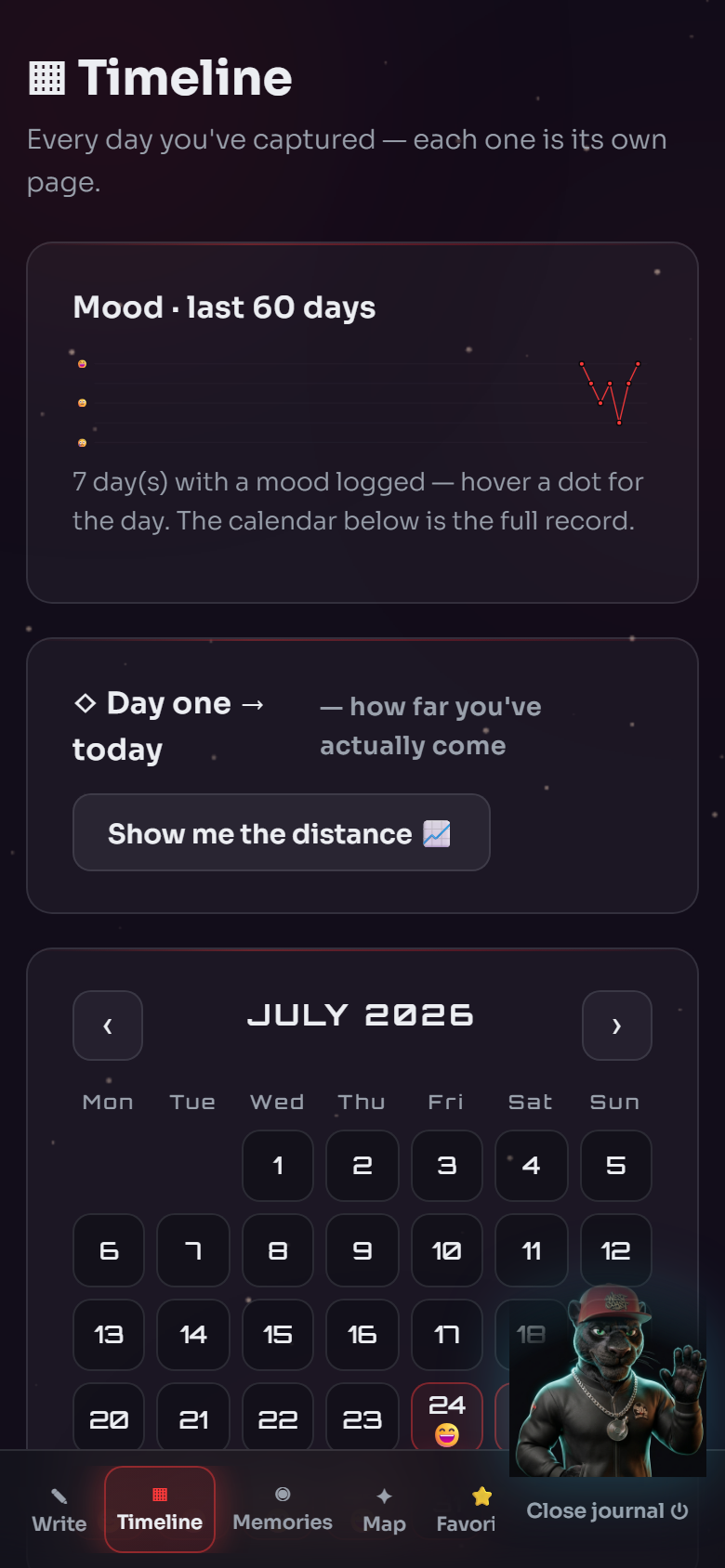
The searchable personal journal timeline in LIZAX JOURNAL. Use the workbook actions in this guide to carry an exercise into your own private entry.
The Core Anchors of a Searchable Personal Memory Library
A living memory library relies on structured categories that bridge sensory triggers with narrative context. In LIZAX JOURNAL, searchable favorites organize your life story into distinct, interconnected threads [F5].
People & Relationships
Catalog meaningful conversations, milestone events, shared jokes, and personal traits. Searching a person's name brings up every entry, photograph, and shared memory associated with them.
Places & Coordinates
Anchor reflections to physical geography—from neighborhood coffee spots to international travels—ensuring local discoveries and travel narratives are never lost.
Dishes, Songs & Cultural Anchors
Link sensory details like family recipes, dinner party menus, favorite tracks, and beloved books [F5] directly to the emotional moments where they occurred.
Photographs & Voice Clips
Combine visual imagery and audio tone with text notes, creating a rich multi-sensory archive that preserves how a moment actually felt.
Why Context Matters: Moving Beyond Keywords
Searchability is only as powerful as the context surrounding it. Typing the word 'pasta' into a basic notes app might return fifty disconnected results. In contrast, a contextual memory library records *why* that meal mattered: the rainstorm outside, the playlist playing in the background, the exact vintage of wine shared, and the conversation that took place across the table.
When emotional state, physical environment, and sensory inputs are logged together, reading a past entry triggers authentic neural recall. Furthermore, privacy remains paramount when building a personal archive. In LIZAX JOURNAL, public articles or external guides are never automatically copied into private journal entries; members retain absolute ownership over what they write, save, or import [F2].
Try This in Your Journal: Constructing a Multi-Sensory Entry
To build a robust memory library, follow this simple structured format whenever you record a significant day, outing, or milestone inside LIZAX JOURNAL.
Step 1: Capture the Core Narrative via Voice or Text
Use voice input or typing to record the central narrative [F1]. Speak freely about what happened and how you felt, focusing on candor over polished prose.
Step 2: Tag Specific Sensory and Spatial Anchors
Attach specific entities to the entry: name the restaurant or park under Places, list the exact dish or recipe under Dishes, and add the background track under Songs [F5].
Step 3: Add Media and Emotional Markers
Attach 1–3 candid photographs [F1] and log your primary emotional state or prevailing habit to ground the entry in physical and internal reality.
Step 4: Save to Favorites for Rapid Retrieval
Mark exceptional entries, recipes, or locations as Favorites [F1, F5] so they are indexed directly into your primary library dashboard for instant future search.
The Step-by-Step Monthly Organizing Ritual
Building an archive should never feel like administrative chores. Dedicate 20 minutes at the end of each month to run this simple organizing ritual.
Step 1: Review Your Automated Monthly Reflection
Open your monthly review inside LIZAX JOURNAL [F1] to see synthesized patterns across your habits, emotional states, and frequently visited locations.
Step 2: Consolidate Standout Dishes, Songs, and Books
Ensure new recipes cooked, songs repeated on loop, or books finished during the month are assigned to your searchable Favorites library [F5].
Step 3: Update Person & Place Connections
Review entries involving key people in your life. Add quick notes regarding birthdays, evolving relationship dynamics, or memorable quotes.
Step 4: Curate Imagery for Your Annual Yearbook
Select your top 5 photographs from the month to ensure they are formatted and staged for your eventual end-of-year printable yearbook [F1].
System Architecture: How LIZAX Protects Memory Integrity
Maintaining clarity in a personal library requires intelligent boundaries. LIZAX JOURNAL employs clear architectural rules to keep your personal records clean, focused, and completely private.
Bounded Coach Memory
Your chosen AI coach uses a strictly bounded rolling summary capped at 600 words for lasting personal facts [F3]. This ensures coaching responses remain relevant without cluttering your main archive.
Separation of Full Entries
While the coach references a concise summary [F3], your complete private entries remain isolated, full-length records dedicated entirely to your archive.
Strict Exclusion Rules
Generated drafts, blog copy, creative scripts, research text, and coach prose are explicitly excluded from memory condensation [F4], ensuring your library only indexes your true personal history.
Printable Tangibility
Digital searchability meets physical heirloom quality through automated monthly reviews and a gorgeous printable yearbook option [F1].
We believe your life's details—the music you cooked to, the small cafes you stumbled upon, and the emotional quiet of ordinary Sundays—deserve to be preserved with the same dignity and precision as major life milestones.
A Mission for Personal Memory
Start Building Your Searchable Memory Library Today
Transform your daily entries, voice notes, photos, and favorite moments into an organized, permanent archive with LIZAX JOURNAL.
How does searching work across different memory types in LIZAX JOURNAL?
LIZAX JOURNAL features built-in searchable favorites for people, songs, dishes, recipes, places, books, activities, products, and general memories [F5]. You can search by keyword, tag, person, or category to instantly surface past entries and attached media.
Is my private journal data used to train public AI models?
No. Your entries are completely private. Members choose what they write or save, and public articles or external content are never automatically copied into private journal entries [F2]. Furthermore, strict exclusion rules prevent external text from altering your personal memory archive [F4].
How does the AI coach remember my background details?
Your AI coach utilizes a bounded rolling summary capped at 600 words to remember key, lasting personal facts [F3]. This allows the coach to provide personalized, context-aware responses while your full private journal entries remain completely separate [F3].
Can I convert my digital memory library into a physical book?
Yes. LIZAX JOURNAL includes features for monthly reviews and automatically helps curate your entries into a printable yearbook at the end of the year [F1].
FROM EDUCATION TO PERSONAL ACTION
Use this insight inside LIZAX JOURNAL
This article remains public educational content. Inside the private journal, you decide whether to apply it to your own life, save a reflection or discuss it with your coach.
Connected memory systemKeep the entry, people, photographs, places and meaningful details connected to their original story.See how this feature works →
One Life Coach Operating SystemThe journal, memory, goals, timeline, map, favorites, coach and books are connected views—not separate journals.Explore the complete system →
Try it without an accountUse fictional sample data to feel the raw-words-to-coaching transformation. Nothing is saved and no paid AI call is made.Open the interactive demo →
Sources & verified facts
Product: A private AI journal with voice input, long-term condensed memory, a choice of coaches, photos, favorites, places, habits, emotional reflection, monthly reviews and a printable yearbook.
Private app behavior: Members choose what they write or save; public articles are not automatically copied into private journal entries.
Coach memory: The coach uses a bounded rolling summary capped at 600 words for lasting personal facts, while full private entries remain separate.
Memory exclusions: Generated drafts, blog copy, scripts, research text and the coach's prose are explicitly excluded from personal memory condensation.
Library tools: The journal supports searchable favorites for people, songs, dishes, recipes, places, books, activities, products and memories.
LIZAX JOURNAL is a digital self-care tool designed for personal reflection, emotional clarity, and private life archiving. It is not a clinical mental health service, medical diagnostic tool, or replacement for professional therapy.
Authoritative resource
For official guidance on caring for family papers and photographs, consult the U.S. National Archives alongside the organizational workflow in this guide.