A LIZAX JOURNAL visual created for this guide. The practical journal exercise appears below.
Why Hard Choices Demand a Decision Journal
When facing high-stakes personal or professional crossroads, our brains naturally attempt to avoid regret rather than analyze reality. We conflate good decisions with good outcomes and bad decisions with bad luck. A decision journal for hard choices interrupts this cognitive bias by forcing you to document your thinking state in real time before the result is known. By explicitly capturing what you knew, what you assumed, and what you felt at the exact moment of choice, you create an honest historic record. Journaling interventions have been studied across health and wellness contexts for their role in emotional reflection and mental clarity [S1]. However, writing down a decision framework does not eliminate future risk or guarantee success; instead, it establishes an objective baseline. When you return to past entries during monthly reviews, you evaluate the quality of your reasoning rather than judging yourself solely through hindsight.
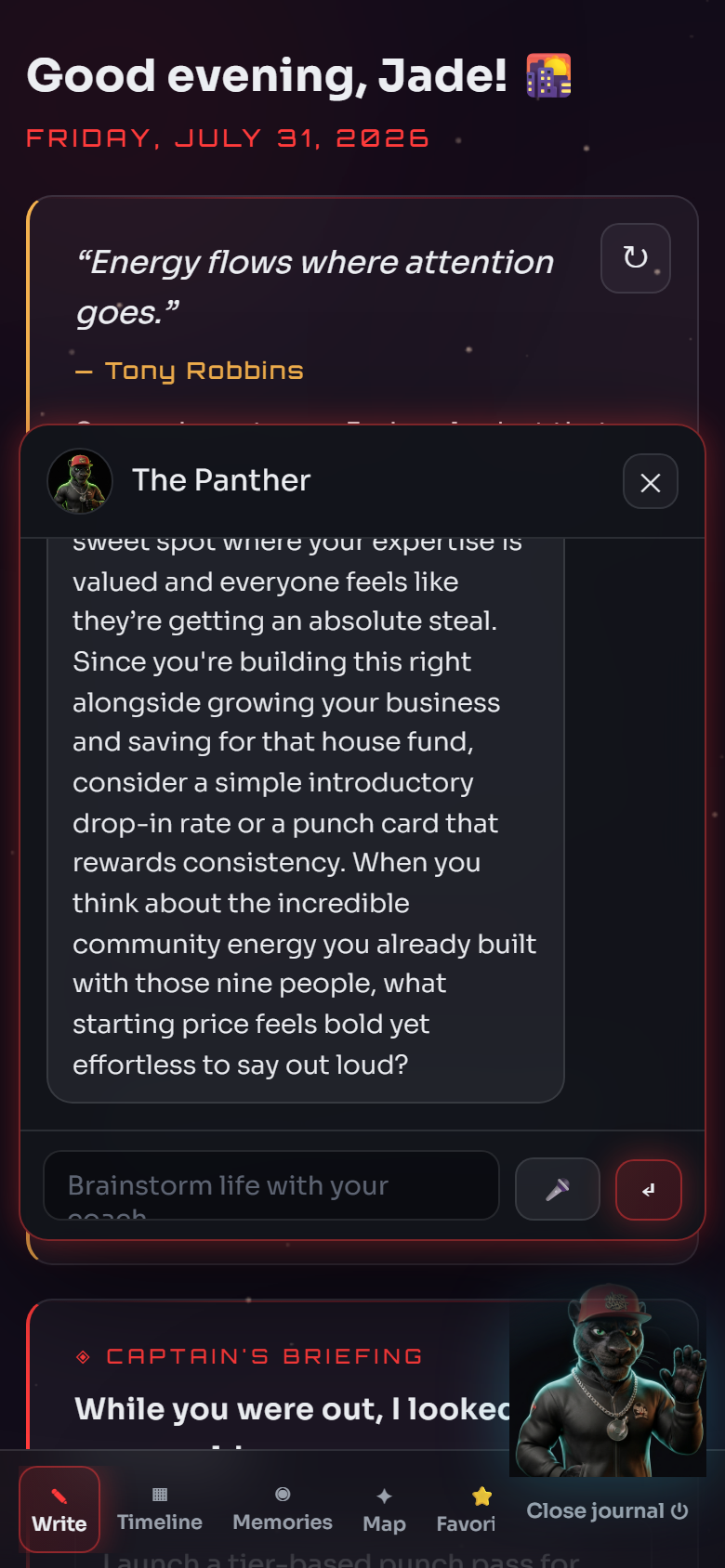
The journal's private AI coach conversation in LIZAX JOURNAL. Use the workbook actions in this guide to carry an exercise into your own private entry.
The Core Components of a Hard-Choice Entry
To build an effective decision log, move beyond unstructured venting and systematically address the core variables of your choice.
Known Facts vs. Working Assumptions
Separate what is indisputably true from what you are assuming. Highlighting your assumptions allows you to monitor which unverified beliefs drive your decision.
Values, Tradeoffs, and People Affected
Identify which core values take priority in this choice and acknowledge what you are giving up. Explicitly list the people impacted and how their needs factor into your judgment.
Reversible Tests and Hard Deadlines
Determine if the choice is a one-way or two-way door. Design small, reversible experiments where possible and set a firm deadline to prevent analysis paralysis.
Falsification Criteria
Define what would change your decision in the future. Establishing clear triggers ahead of time prevents ego-driven commitment to a failing path.
Try this in your journal
Use these practical steps inside your Lizax Journal to structure your next complex decision using dedicated voice, tags, and reflection tools [F1].
Step 1: Dictate your initial thoughts via voice input
Open a new entry and use voice input to speak candidly about the dilemma, your emotional state, and immediate instincts without self-censoring [F1].
Step 2: Map key entities, favorites, and people
Tag specific people, places, or active projects involved using your searchable favorites library to keep contextual links clean across your journal [F5].
Step 3: Document tradeoffs and falsification triggers
Create bulleted sections for facts, assumptions, core values, reversible tests, and exact conditions that would prove your strategy wrong.
Step 4: Schedule a review in your monthly check-in
Set a reminder to re-examine this decision entry during your next monthly review to assess your reasoning against new real-world data [F1].
Clarity is not the absence of uncertainty; it is the courage to name your tradeoffs and own your reasoning before the outcome unfolds.
Reflecting on Uncertainty
Separating Process from Outcome: Realities and Limitations
A critical mistake when keeping a decision log is assuming that thorough analysis guarantees a favorable outcome. Reality remains probabilistic, and unexpected variables will always exist. Research systematically evaluating journaling tools indicates that expressive and structured writing can assist in managing psychological distress and fostering emotional clarity [S1]. However, journaling is a self-reflection tool, not a clinical treatment or an oracle for future events [S1]. Make a note about this in your journal whenever you feel overwhelmed by a choice: document your immediate emotional state alongside your logical points so you can track both over time [F1]. If you feel stuck between competing priorities, ask your coach to help you dissect your assumptions without imposing a decision on you [F1]. Ultimately, decision journaling builds trust in your capacity to reason under pressure, regardless of how external circumstances unfold.
Structuring Hard Choices in Lizax Journal
Lizax Journal combines private reflection tools with intelligent memory boundaries to help you process complex decisions over time [F1][F3].
Private Entry Control
You retain total ownership over what you record; public articles or external guides are never automatically copied into your private journal [F2].
Bounded Coach Memory
Your coach retains key context through a bounded rolling summary capped at 600 words for lasting personal facts while keeping full private entries separate [F3].
Clean Memory Boundaries
Generated drafts, blog copy, scripts, research text, and coach prose are explicitly excluded from your personal memory condensation [F4].
Printable Yearbook Records
Transform your annual decision logs, photos, habits, and milestone reviews into a permanent, beautifully bound printable yearbook [F1].
Bring Clarity to Your Next Big Choice
Start documenting your decisions with voice input, structured reflections, and long-term memory support in a private journal designed for personal growth [F1].
Does a decision journal guarantee I will make the right choice?
No. A decision journal clarifies your reasoning, facts, and assumptions at the time of the decision. It cannot eliminate uncertainty or control external outcomes, but it helps you learn from your process objectively.
How does Lizax Journal keep my decision entries private?
You control everything you write or record. Public articles are never auto-copied to your journal [F2], and coach context uses a bounded 600-word summary while keeping full private entries separate [F3].
What should I do if a decision turns out poorly?
Revisit your original decision entry. Check whether your assumptions were flawed or if unexpected external variables caused the outcome. This separates poor decision-making from bad luck.
Can I track the people and places involved in my decisions?
Yes. Lizax Journal includes searchable favorites for people, places, books, activities, products, and memories so you can link context across entries over time [F5].
FROM EDUCATION TO PERSONAL ACTION
Use this insight inside LIZAX JOURNAL
This article remains public educational content. Inside the private journal, you decide whether to apply it to your own life, save a reflection or discuss it with your coach.
Goals and next actionsTurn what this article brings up into a prioritized goal, a supplied deadline and a smaller next step.See how this feature works →
One Life Coach Operating SystemThe journal, memory, goals, timeline, map, favorites, coach and books are connected views—not separate journals.Explore the complete system →
Try it without an accountUse fictional sample data to feel the raw-words-to-coaching transformation. Nothing is saved and no paid AI call is made.Open the interactive demo →
Sources & verified facts
Product: A private AI journal with voice input, long-term condensed memory, a choice of coaches, photos, favorites, places, habits, emotional reflection, monthly reviews and a printable yearbook.
Private app behavior: Members choose what they write or save; public articles are not automatically copied into private journal entries.
Coach memory: The coach uses a bounded rolling summary capped at 600 words for lasting personal facts, while full private entries remain separate.
Memory exclusions: Generated drafts, blog copy, scripts, research text and the coach's prose are explicitly excluded from personal memory condensation.
Library tools: The journal supports searchable favorites for people, songs, dishes, recipes, places, books, activities, products and memories.