A LIZAX JOURNAL visual created for this guide. The practical journal exercise appears below.
The Evolution of Personal Reflection
For centuries, physical notebooks have served as an intimate sanctuary for raw human thought. Sliding a pen across paper slows down cognition, offering kinesthetic grounding after hours spent staring at backlit displays. However, modern life presents creative and logistical challenges that paper alone struggles to resolve. Systematic reviews show that structured journaling can meaningfully support mental well-being and emotional regulation, though it remains a self-directed practice rather than a replacement for clinical care or professional therapy [S1]. The central choice between paper and digital journaling is not about deciding which medium is universally superior; it is about recognizing which tool solves your specific friction points in reflection, searching past memories, and preserving your legacy. Make a note about this in your journal: Write down what physical or digital friction currently keeps you from capturing your daily thoughts consistently.
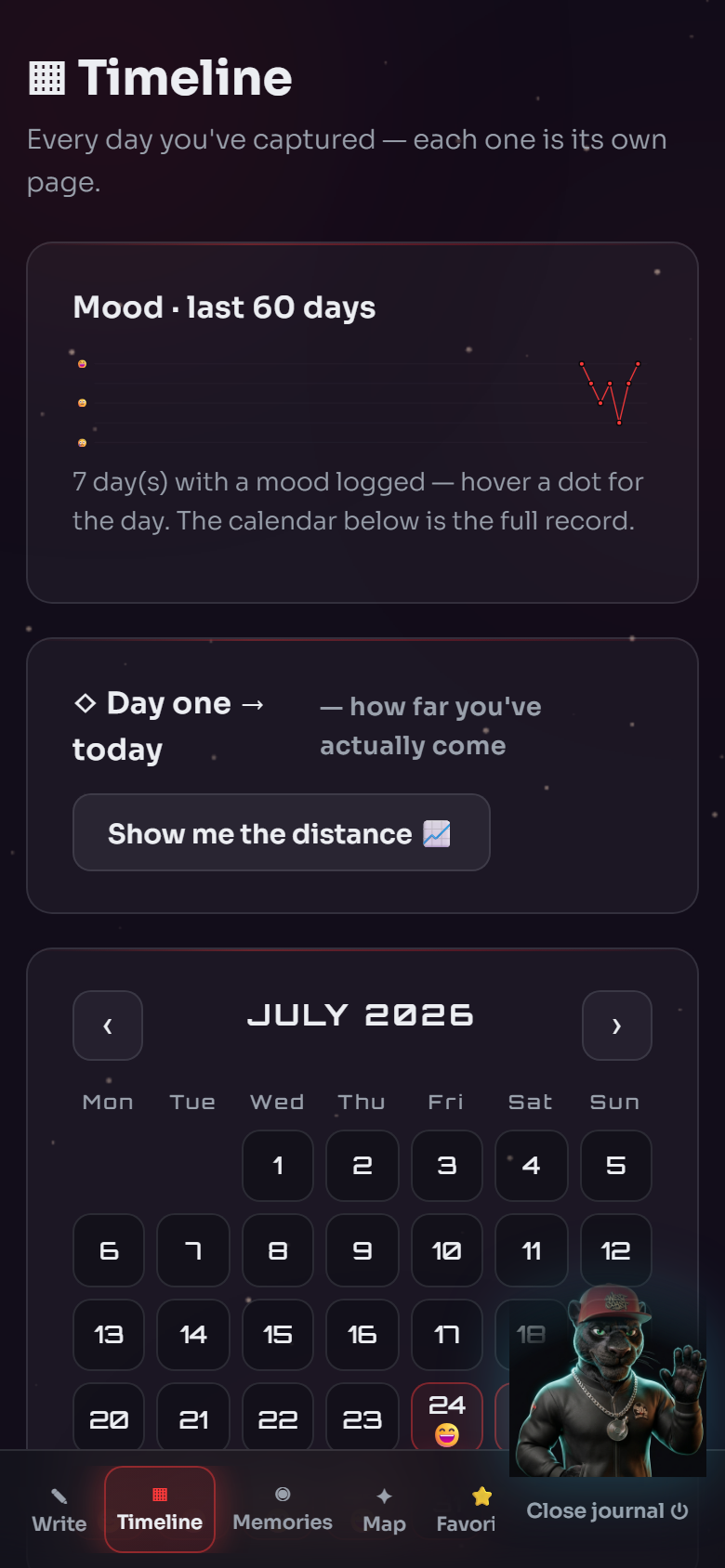
The searchable personal journal timeline in LIZAX JOURNAL. Use the workbook actions in this guide to carry an exercise into your own private entry.
When Paper Remains the Superior Choice
Despite technological advances, traditional paper notebooks offer distinct tactile advantages that digital devices cannot fully replicate. Understanding where paper excels helps you build a practice that honors your natural focus.
Sensory and Kinesthetic Grounding
The physical friction of ink on paper engages motor pathways that encourage deliberate, contemplative thinking, helping unclutter an overstimulated mind.
Unplugged Solace
A physical journal requires zero electricity, emits no blue light, and carries no notifications, making it ideal for evening wind-down rituals.
Spontaneous Formatting Freedom
Paper allows unconstrained sketching, marginal notes, spatial mind-mapping, and chaotic scribbling without strict software boundaries.
When Digital Journaling Unlocks New Depth
Digital journaling transforms quiet daily entries into a searchable, multidimensional archive of your life. By leveraging modern capture tools, your reflection moves from static pages to an active personal mirror.
Instant Voice Input and Portability
Speak your candid thoughts while walking or commuting using voice input, removing typing fatigue during emotionally exhausting days [F1].
Searchable Lifelong Memory
Easily retrieve entries across years by querying specific people, favorite songs, dishes, recipes, places, books, activities, or products [F5].
Rich Multimedia & Habit Integration
Combine emotional reflections with photos, place tags, habit tracking, and monthly synthesized reviews to see your growth clearly over time [F1].
Try this in your journal
Follow these practical steps within LIZAX JOURNAL to combine spontaneous daily capture with long-term emotional clarity.
1. Speak your daily reflection
Use voice input during a walk or after dinner to quickly capture raw feelings without worrying about spelling or neatness [F1].
2. Log your contextual favorites
Tag the specific places, songs, recipes, or books connected to your day to build a rich, searchable personal library [F5].
3. Review your rolling coach summary
Check your coach's bounded 600-word summary to observe recurring themes while keeping your full private entries safe and separate [F3].
4. Print your annual yearbook
At the end of the year, convert your digital record into a beautifully printed yearbook to enjoy the permanence of physical paper [F1].
Privacy, Data Control, and Archival Preservation
Preserving your life story requires balancing long-term durability against privacy. Physical notebooks face tangible risks over time: water damage, fire, or ink fading require strict storage standards involving light control, steady humidity, and acid-free paper to ensure decades of survival [S2]. Digital tools eliminate physical degradation but demand robust privacy architecture. In LIZAX JOURNAL, privacy is foundational: members choose what they write or save, and public articles are never automatically copied into private entries [F2]. To protect your personal depth, the AI coach operates on a bounded rolling summary capped at 600 words for lasting facts, while full entries remain completely separate [F3]. Furthermore, generated drafts, blog copy, scripts, and research text are explicitly excluded from personal memory condensation [F4]. Ask your coach: 'Based on my recent entries, what emotional patterns or habits keep surfacing when I feel stressed?'
Your journal should not demand stylistic perfection; it should preserve your candid truth across every season of life.
A Permanent Record of Who You Are
Build a Journaling Practice That Adapts to You
Whether you choose to write by hand or speak your thoughts into a private AI space, keeping a daily journal is one of the most transformative habits you can build. Experience the searchability, emotional coaching, and rich memory of LIZAX JOURNAL today, and turn your digital entries into a tangible physical yearbook whenever you choose [F1].
Can I use both a paper journal and a digital journal together?
Yes. Many writers use a physical notebook for quick morning brain-dumps or screen-free evening relaxation, while relying on LIZAX JOURNAL for voice input, photo archives, searchable favorites, and automated monthly reviews [F1, F5].
Is a digital journal really as private as a physical notebook locked in a drawer?
Physical notebooks can be misplaced or read by anyone who finds them. In LIZAX JOURNAL, your entries remain strictly private, you choose what to save [F2], and coach summaries are bounded to a rolling 600-word memory while keeping full entries separate [F3].
How does digital journaling prevent memory loss over time?
Unlike paper notebooks sitting on a shelf, digital journals allow instant searching across years of entries by person, place, book, or emotional habit [F5]. LIZAX JOURNAL also generates monthly reviews and offers a printable annual yearbook to bridge digital search with physical preservation [F1].
FROM EDUCATION TO PERSONAL ACTION
Use this insight inside LIZAX JOURNAL
This article remains public educational content. Inside the private journal, you decide whether to apply it to your own life, save a reflection or discuss it with your coach.
AI journal and contextual coachCapture the reflection in your own words and ask a coach that can use bounded, editable personal context.See how this feature works →
One Life Coach Operating SystemThe journal, memory, goals, timeline, map, favorites, coach and books are connected views—not separate journals.Explore the complete system →
Try it without an accountUse fictional sample data to feel the raw-words-to-coaching transformation. Nothing is saved and no paid AI call is made.Open the interactive demo →
Sources & verified facts
Product: A private AI journal with voice input, long-term condensed memory, a choice of coaches, photos, favorites, places, habits, emotional reflection, monthly reviews and a printable yearbook.
Private app behavior: Members choose what they write or save; public articles are not automatically copied into private journal entries.
Coach memory: The coach uses a bounded rolling summary capped at 600 words for lasting personal facts, while full private entries remain separate.
Memory exclusions: Generated drafts, blog copy, scripts, research text and the coach's prose are explicitly excluded from personal memory condensation.
Library tools: The journal supports searchable favorites for people, songs, dishes, recipes, places, books, activities, products and memories.