The Best Possible Self Journal Exercise: Science, Flow, and Practice
A structured, 15-minute positive expressive-writing framework designed to clarify your future vision, foster emotional well-being, and ground aspirations in practical daily reflection.
A LIZAX JOURNAL visual created for this guide. The practical journal exercise appears below.
Understanding the Best Possible Self Journal Exercise
The Best Possible Self (BPS) exercise is a structured intervention derived from positive psychology and expressive-writing research [S1]. Unlike passive daydreaming or vague affirmations, this exercise asks you to imagine a future time—typically 1 to 5 years ahead—where you have worked hard, overcome obstacles, and achieved your highest potential across key life domains [S1]. Systematic reviews on positive expressive writing indicate that writing about future success and personal strengths can enhance subjective well-being and positive mood compared to control writing tasks [S1].
The power of the exercise lies in cognitive structure. When you write down a vivid narrative of your best possible self, you transform abstract desires into concrete, mentally accessible concepts [S1]. This process encourages self-regulation by clarifying what truly matters to you, distinguishing intrinsic goals (such as meaningful relationships, health, and personal growth) from external pressures. By engaging in this exercise regularly or returning to it periodically, you create a baseline for personal reflection and daily decision-making.
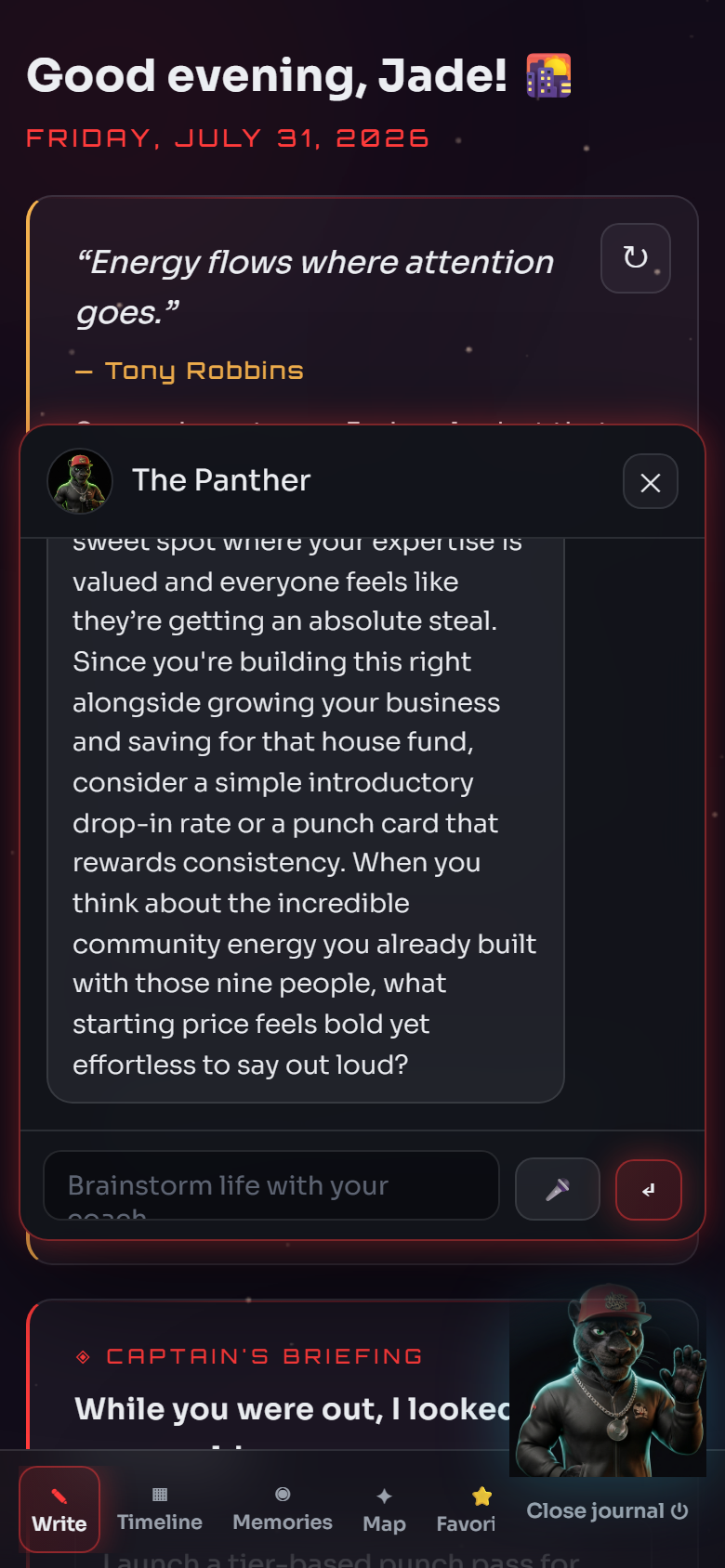
The journal's private AI coach conversation in LIZAX JOURNAL. Use the workbook actions in this guide to carry an exercise into your own private entry.
Preparation: Setting the Scene Before You Write
Choose an Uninterrupted Space
Find a quiet location where you will not be disturbed for at least 20 minutes. Turn off notifications and set aside external demands so you can fully focus on your internal vision.
Adopt a Mindset of Freedom and Possibility
Temporarily set aside self-doubt, pragmatic constraints, and fear of failure. Assume that everything has gone as well as it realistically could through effort, skill, and favorable circumstances.
Write Continuously Without Editing
Focus on the flow of thoughts rather than grammar, spelling, or formal structure. Expressive writing works best when you record your honest, raw reflections without self-censorship [S1].
The 15-Minute Best Possible Self Writing Flow
Minutes 0–3: Core Personal Vision & Health
Describe your future physical and mental health, emotional vitality, and personal character. How do you feel waking up in the morning? What habits, energy levels, and mindset define your daily life?
Minutes 3–7: Relationships, Home & Community
Detail the people surrounding you—family, partners, friends, or community. How do you communicate, express care, and share experiences? Describe your home environment and the atmosphere you cultivate.
Focus on your professional life, creative projects, or personal passions. What meaningful work or skills are you mastering? How do you contribute value and experience accomplishment?
Minutes 11–15: Integration & Emotional Grounding
Summarize how these pieces fit together. Reflect on the underlying values—such as freedom, integrity, compassion, or resilience—that unite your best possible self narrative.
Post-Writing Reflection Questions
Which Themes Surprised You?
Identify any unexpected priorities or goals that emerged during your continuous writing flow.
What Character Strengths Were Present?
Pinpoint the specific qualities—such as patience, discipline, curiosity, or empathy—that enabled your best possible self to succeed.
What Small Gap Can You Close Today?
Highlight one concrete action or attitude from your future vision that you can bring into your routine immediately.
Translating Vision into Daily Actionable Habits
Writing about your best possible self offers cognitive benefits, but bridging the gap between narrative vision and actual daily life requires steady, incremental actions [S1]. Once your writing session is complete, examine the narrative for repeating themes, specific habits, and favored environments. If your future self prioritizes physical vitality and deep focus, examine how your present daily calendar supports or hinders those states.
To keep your vision active, catalog key elements from your exercise—such as favorite books, inspiring places, foundational habits, or core values—into dedicated reference lists [F5]. Returning to these anchor points throughout the month helps prevent your best-possible-self insights from fading into background noise, turning emotional clarity into consistent, quiet progress.
Try this in your journal
1. Speak or Type Your 15-Minute Flow
Open Lizax Journal and choose voice input for a hands-free, stream-of-consciousness entry or type directly [F1]. Note that your personal journal entry remains entirely private and secure [F2].
2. Tag Key Details to Your Searchable Favorites
Identify specific places, activities, books, or habits mentioned in your stream and save them to your searchable favorites library for quick future reference [F5].
3. Engage with Your AI Coach for Insightful Reflection
Select your preferred reflective coach to explore your entry [F1]. Your coach utilizes a bounded rolling summary capped at 600 words for lasting personal facts [F3], while keeping your full private entries separate [F3]. Generated drafts or research notes are excluded from memory condensation [F4].
4. Ask Your Coach Prompt
Make a note about this in your journal and prompt your assistant: 'Ask your coach: Based on my best possible self entry, what is one small, practical daily habit I can track this week to align with this vision?' [F1][F3]
Revisiting Your Entry After 30 Days
Conduct a Monthly Reflection Review
At the end of the month, utilize monthly review tools to compare your current routine, mood patterns, and active habits against your original exercise [F1].
Track Incremental Growth
Evaluate which aspects of your best possible self have begun to manifest in small daily choices, shifts in perspective, or renewed boundaries.
Archive Your Evolution in a Printable Yearbook
Preserve your monthly reflections, photos, and expressive milestones as part of a permanent printable yearbook that documents your long-term personal journey [F1].
Evidence, Nuance, and Scope of Positive Expressive Writing
While positive expressive-writing exercises like the Best Possible Self protocol show promising outcomes for subjective well-being and positive mood in systematic reviews, it is essential to understand their limitations [S1]. Expressive journaling is a tool for personal growth, self-reflection, and goal clarity—it is not a clinical treatment, psychotherapeutic intervention, or substitute for professional mental health care [S1].
Individual responses to expressive writing vary. Factors such as baseline emotional state, writing consistency, and personal engagement influence how beneficial the exercise feels over time [S1]. Rather than expecting immediate life transformations, treat the exercise as a practical, periodic check-in that helps align your everyday habits with your long-term values.
Journaling is not about performing for an audience—it is about articulating your honest aspirations so you can walk toward them with clarity and intent every single day.
Reflective Growth
Start Your Best Possible Self Practice Today
Capture your thoughts through voice or text, build long-term reflection summaries, and preserve your personal growth story in a stylish private space.
How often should I do the best possible self journal exercise?
Many participants find value in completing the exercise once every few months or at key transitions (such as the start of a new season or year) to refresh their long-term vision and align daily habits.
What if I find it difficult to imagine a positive future?
It is normal to experience resistance or doubt. Start small by focusing on a single domain—such as a peaceful morning routine or a comforting home environment—and expand from there without pressure.
Is the best possible self exercise scientifically proven?
Systematic reviews of positive expressive writing show that exercises focused on future potential and strengths can improve subjective well-being and positive affect [S1]. However, outcomes vary based on individual engagement and consistency [S1].
Does journaling replace therapy or counseling?
No. Journaling is a self-reflective wellness practice and educational exercise. It does not diagnose, treat, or substitute for clinical mental health care or professional medical advice.
FROM EDUCATION TO PERSONAL ACTION
Use this insight inside LIZAX JOURNAL
This article remains public educational content. Inside the private journal, you decide whether to apply it to your own life, save a reflection or discuss it with your coach.
AI journal and contextual coachCapture the reflection in your own words and ask a coach that can use bounded, editable personal context.See how this feature works →
One Life Coach Operating SystemThe journal, memory, goals, timeline, map, favorites, coach and books are connected views—not separate journals.Explore the complete system →
Try it without an accountUse fictional sample data to feel the raw-words-to-coaching transformation. Nothing is saved and no paid AI call is made.Open the interactive demo →
Sources & verified facts
Product: A private AI journal with voice input, long-term condensed memory, a choice of coaches, photos, favorites, places, habits, emotional reflection, monthly reviews and a printable yearbook.
Private app behavior: Members choose what they write or save; public articles are not automatically copied into private journal entries.
Coach memory: The coach uses a bounded rolling summary capped at 600 words for lasting personal facts, while full private entries remain separate.
Memory exclusions: Generated drafts, blog copy, scripts, research text and the coach's prose are explicitly excluded from personal memory condensation.
Library tools: The journal supports searchable favorites for people, songs, dishes, recipes, places, books, activities, products and memories.
This article is for educational and self-reflection purposes only and does not constitute medical, psychological, or clinical advice. Expressive journaling is a wellness tool and is not a substitute for professional mental health diagnosis or treatment.